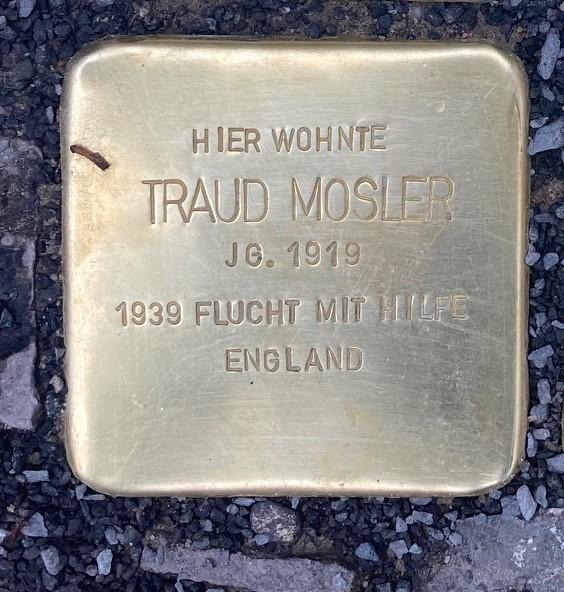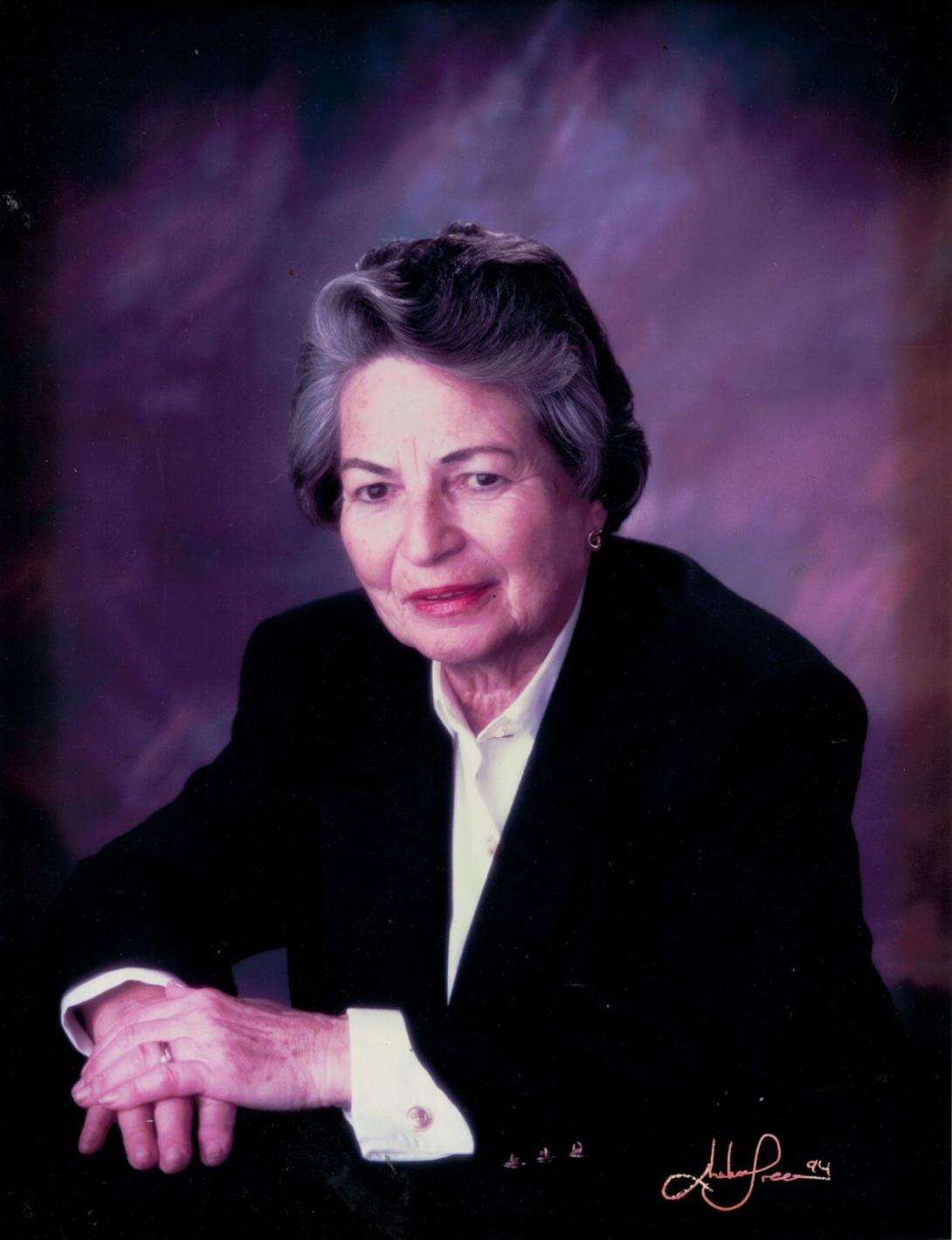
Traud Mosler was born on September 8, 1919 in Berlin as the first child of Frida and Kurt Mosler. Her brother Werner was born three years later on November 23, 1922. The Jewish banking family initially lived for a few years in Berlin Lichterfelde at Lorzingstrasse 4 before moving into the newly built villa at Rothenburgstrasse 24 in Steglitz in 1925.
Traud attended elementary school in Steglitz from 1926 to 1930, then she transferred to the Auguste-Victoria-Lyzeum in Steglitz, which she was forced to leave in 1936.
In her curriculum vitae, which Traud attached to her application for compensation in 1956, she described the Impairment of her educational and professional development as follows:
"I wanted to get my high school diploma and go to university. I wanted to study mathematics and also train as a sports teacher so that I could work as a teacher in both subjects. But as a Jew I had to leave school in 1936 and found no way to take the school leaving examination. I was a good student and particularly good at mathematics.
I then tried to take up a practical profession and to become a professional seamstress But there were no more opportunities for Jewish apprentices. The public tailoring academies no longer accepted Jewish apprentices. I then went to a private Jewish tailoring school run by Mrs Adele Stelitz in Berlin-Halensee, where I learned to tailor half-days for about a year; a method that was in no way comparable to a proper tailoring apprenticeship.
So I went to my father's shop (Norm-Kleindruck-Vertrieb, Berlin SW 68, Wilhelmstr. 33) and helped out a little in the office. But that only lasted until December 1938. Then my father's business had to be sold under pressure. My father received no payment for this "sale," which he was forced to make under threat of imprisonment in a concentration camp. The buyer was presented by the
Gestapo
and paid a deposit of approximately 150 Reichsmarks."
Traud left Berlin on March 14, 1939, together with her fiancé and later first husband Gerhard Chaim, for Leeds, England.
Her brother Werner followed her at the end of July 1939.
Her parents Kurt and Frida and her grandmother Lydia Mosler stayed behind in Berlin. After the largely forced sale of the house and property at Rothenburgstrasse 24 in April 1939, her parents had to move to Prinzregentenstrasse 4 in October 1939, where they rented a small apartment. Grandmother Lydia died in July 1941.
Starting a new life in England was not easy for Traud. She described it to the German authorities in her written CV as follows:
"In England I went into domestic work, the first seven months I was in Liverpool, then in Leeds and had several jobs in a row. I eventually had day jobs in the household, where I earned a little more but had to pay for my room. From September or October 1940 to November 1941 I did sewing work for a shop in Leeds. I had to support myself and pay for my room with that. In my next similar job I was earning £2 a week.
At the beginning of 1943 I moved to London, where I earned £2.10 a week in a clothing factory in the East End. I continued this until April 1944."
Traud married her second husband, Leopold Heller, on February 18, 1944. In April 1944, she stopped working as a seamstress in the clothing factory because she was expecting her first child. Traud and Leopold Heller had two sons, Ralph and Clive and five grandchildren. During her time in England, Traud became heavily involved in the charitable work of the Leo Baeck Lodge. She was particularly interested in raising funds for needy children. In her later years, she helped distribute meals every week at a Jewish old people's home, even though she was older than many of the recipients.
Traud's parents were murdered in Auschwitz in 1943: Traud's father Kurt was deported on March 2. 1943, Traud's mother Frida on March 4, 1943.
Traud Heller, née Mosler, died on January 5, 2006 in London.
Her brother Werner had already died on April 27, 2000 in London.
All texts and images on this website are protected by copyright and may not be used without the permission of the copyright holder.