
- Location
- Bornstr. 1
- District
- Friedenau
- Stone was laid
-
30 April 2024
- Born
- 04 December 1889 in Minden
- Occupation
- Speditionskaufmann
- Escape
- 1939 Shanghai
- Arrested
-
von 10 November 1938 to bis 13 December 1938 in Sachsenhausen
-
Survived
-
 Stolperstein Alfred Lilienthal © S. Davids
 -
ca. 1931 Familie Lilienthal © Familienbesitz
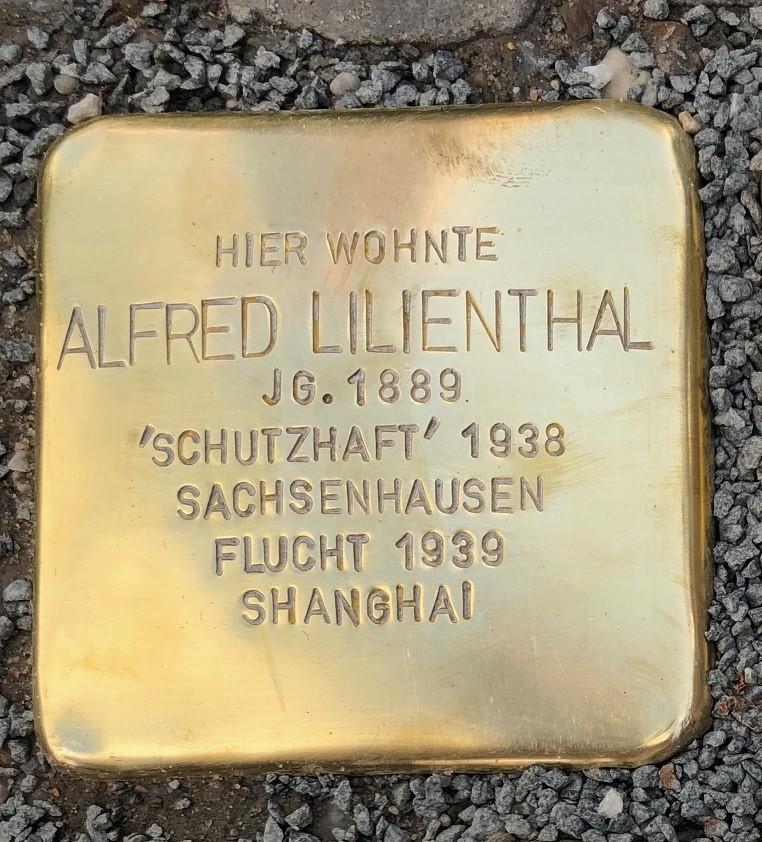
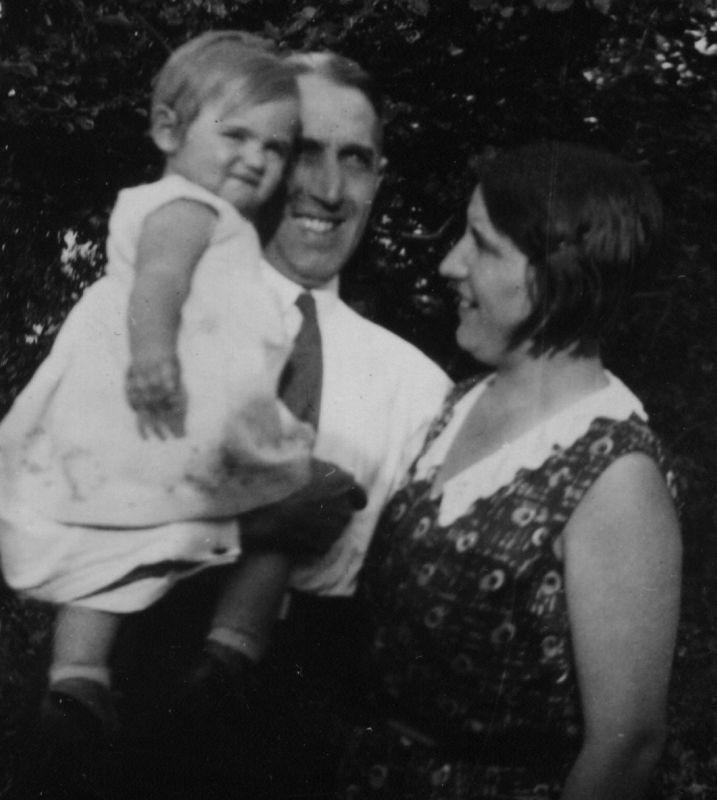
Alfred Lilienthal was born on December 4, 1889, in Minden. His parents, the merchant Bruno (Bendix) Lilienthal (born September 8, 1856, in Minden) and Hulda Liebreich (born August 22, 1862 in Bocholt) already had an older daughter, Johanna, who was born on October 6, 1888, in Minden. The family was Jewish. The family had Alfred Lilienthal's grandfather around the turn of the century, Moses Lilienthal, was a banker and owned a commercial and residential building at 19 Obermarktstrasse in Minden. Obermarktstrasse was later named Lindenstrasse. Bruno and Hulda Lilienthal's family lived at this address with their children, Johanna and Alfred. When Alfred Lilienthal's mother Hulda died in 1934, this street was known as Bäckerstrasse.
Alfred attended middle school and the Royal Evangelical High School in Minden and completed a business apprenticeship in 1909. In 1910/11 he did military service as a one-year volunteer. After military service, he worked as a merchant and freight forwarder in several European countries. He spent time spent in Antwerp, Calais and London in the period from 1911 to 1914. In August 1914, Alfred Lilienthal returned to Germany; he volunteered as a front-line fighter in the First World War, in which he fought until 1918. After the end of the First World War, Alfred Lilienthal returned to his job as a businessman in the transport division in 1919. In Aachen, on May 12, 1923, Alfred Lilienthal married his fiancée Johanne Beckmann, who was born on December 3, 1900 in Hesepe (Osnabrück district). Johanne came from a Protestant family. She worked as a trained office clerk and stenographer.
The young couple moved to Berlin and initially lived at 56 Kommandantenstrasse, apparently subletting, as Alfred Lilienthal is not listed in the Berlin address book. Beginning in 1928, Alfred Lilienthal appears in the Berlin address book with the job title "forwarder" at 5 Belziger Strasse in Schöneberg. Their daughter, Eva, was born on June 10, 1930. Eva was to remain the only child of Alfred and Johanne Lilienthal. In 1932, Alfred Lilienthal became managing director of the transport company where he had been employed since 1919. Unfortunately, it was not possible to determine from the files which company it was. Apparently the promotion made it possible for the family to move into a four-room apartment at 1 Bornstrasse, Staircase II. This representative residential-and-commercial building was a large corner house and stretched from Bornstrasse 1 across Schlossstrasse to Walter-Schreiber-Platz. It was destroyed in World War II. The ruins were demolished and a new, modern department store (then Hertie) was built on the old floor plan. The residential building at 1 Bornstrasse no longer exists.
In 1935, Alfred Lilienthal received the Cross of Honour for frontline fighters, which had been donated a year earlier by Reich President Hindenburg on the occasion of the 20th commemoration of the start of the war in 1914. It was given to Jews at the request of war participants or their families until 1935. Because of his participation in the war and the "award" he received, Alfred Lilienthal, like many other Jewish former front-line soldiers, held on to the hope for a long time after Hitler came to power that, as a Jew, he and his family would not be threatened with further reprisals. In fact, Alfred Lilienthal was released as managing director by his employer in 1937. After the decree of the Reich Ministry of Economics of May 31, 1938, according to which no more contracts could be awarded to Jews/Jewish companies, Alfred was finally terminated on June 1, 1938. In his CV, which he submitted to apply for compensation benefits, Alfred Lilienthal summarized his professional biography as follows:
"After the war, I worked for the same transport company from 1919 to 1938 and was appointed managing director in Berlin in 1932. According to the orders of the 'German Labor Front' in the fall of 1937, I had to give up my long-standing position for racist reasons..."
Immediately after the November pogrom on November 9, 1938, the ordered imprisonment ("protective custody") of around 30,000 male and wealthier Jews began. They were deported by the Gestapo and SS to the three German concentration camps of Buchenwald, Dachau and Sachsenhausen. Their assets were Aryanized and they were forced to emigrate. Alfred Lilienthal was also arrested in November, 1938, and sent to the Sachsenhausen concentration camp . His identity card had already been confiscated in October 1938. On November 29, 1938, Alfred Lilienthal was asked to pay 16,800 Reichsmarks "Jewish property tax" to be paid, which was transferred from his account on December 13, 1938. On December 17, 1938, Alfred Lilienthal was released from prison, with the Gestapo ordering him to leave Germany quickly.
On April 18, 1939, the Lilienthal family boarded the Norddeutsche Lloyd passenger ship, the MS "Scharnhorst," built in 1934/35 in Bremerhaven. The destination was the only port that was still visa-free for Jews, in Shanghai. Melchers & Co., 210 Kiukiang Road, POB 1004, was the arrival address in Shanghai that Alfred Lilienthal specified. Kiukiang Road - now Jiujiang Road - was considered a trading center for European companies and bankers in the 1920s and was considered the "Wall Street of the East". As an internationally active freight forwarder, Alfred Lilienthal probably had contacts overseas, which he now used for his emigration.
In the period from 1938/39 to around 1941, 17,000 - 20,000 Jews fled Europe to Shanghai, including around 7,000 German Jews. As far as is known, the Lilienthal family was initially able to live at a common address. This changed when the Japanese occupation forces set up a ghetto in the Hongkou district of Shanghai in February 1943, in which - in addition to other stateless people and around 100,000 Chinese - all Jewish refugees who had arrived since 1938 had to stay. As a result, Alfred was separated from his wife and daughter. The ghetto residents lived in very small spaces under desolate conditions. They could only leave the ghetto with a pass - Alfred Lilienthal was only issued with such a pass once, when he was supposed to present himself at the German Consulate General, where the couple were advised to consent to a divorce. Johanne was given the prospect of being able to return to Germany in the event of a divorce - but she stayed in Shanghai with her daughter Eva. The Protestant-Jewish couple Alfred and Johanne Lilienthal never divorced.
In August 1945, after the Japanese surrender and the end of World War II, the Americans took command in Shanghai. The ghetto was dissolved. In 1945 the Lilienthal family lived together again at the address of Johanne and Eva Lilienthal at 343/85 Zhang Yang Lu Road. Now most of the Jewish refugees were trying to leave Shanghai; mostly to the USA and Palestine. Beginning in 1947, the Lilienthal family tried to return to Germany. While Johanne and Eva Lilienthal began a six-week return trip by ship to Hamburg in November 1950, Alfred Lilienthal was not able to leave Shanghai until December 20, 1950. When he arrived in Germany, as a "stateless person" he had to go to Föhrenwald, near Wolfratshausen (Bavaria), the last camp that was still open for so-called displaced persons. Alfred Lilienthal was only able to return to Berlin in August 1951.
When they returned to Germany, the family separated: on the ship, Eva met her future husband Jürgen Kurt Jedicke, who found work with the USA Air Force in Wiesbaden. From then on, Eva and her mother Johanne lived in this city. Eva spoke English well because of her stay in Shanghai, and found a job as an interpreter with the USA Air Force in Wiesbaden. In 1954, Eva Lilienthal and Jürgen Kurt Jedicke (later under the name George Jedicke) were married, and their son Peter was born in 1955. In 1956 the young family emigrated with Eva's mother, Johanne, to Canada, where their son Robert was born in 1963 and their daughter June in 1966. Alfred Lilienthal, however, stayed in Berlin. It is not known why he did not head for the USA, which was specified in Föhrenwald as the destination country for his departure. As early as 1951, he submitted several applications for reparation and compensation for the losses of his assets, his time in prison and in the ghetto, and for pension rights. These were rejected several times, but Alfred Lilienthal remained stubborn and was finally compensated after several years. The reclaim of the parents' house on Obermarktstrasse in Minden from grocer Hill, who ran a grocery store in this building and probably had been able to purchase the house cheaply through Aryanization , also ended with a settlement.
Contact with his wife and daughter remained. Alfred Lilienthal died on June 6, 1970 in Charlottenburg. His urn was buried in the cemetery in Wilmersdorf at 81-103 Berliner Strasse. Since the end of the 20-year grave lease in 1990, the grave no longer exists. Alfred's wife Johanne died just three weeks after her husband on June 30, 1970 in Canada.
All texts and images on this website are protected by copyright and may not be used without the permission of the copyright holder.