
- Location
- Bornstr. 1
- District
- Friedenau
- Stone was laid
-
30 April 2024
- Born
- 10 June 1930 in Berlin
- Occupation
- Schülerin
- Escape
- 1939 als Kind mit den Eltern nach Shanghai
-
Survived
-
 Stolperstein Eva Lilienthal © S. Davids
 -
ca. 1938 Eva Lilienthal © Familienbesitz
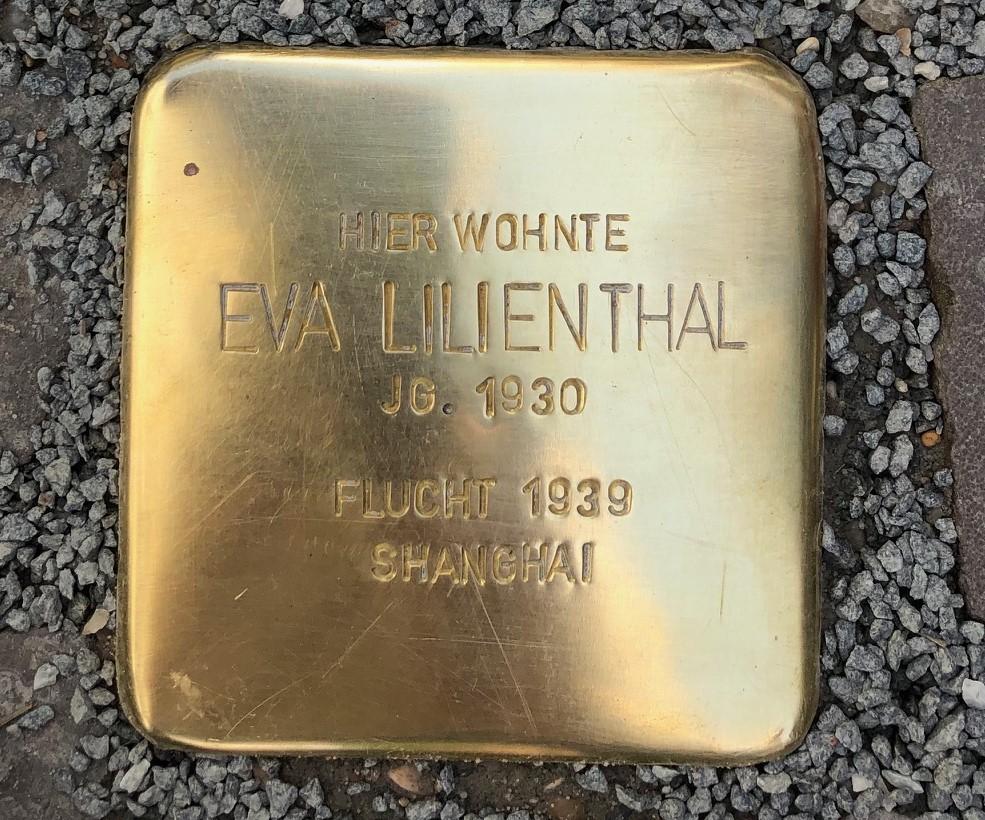
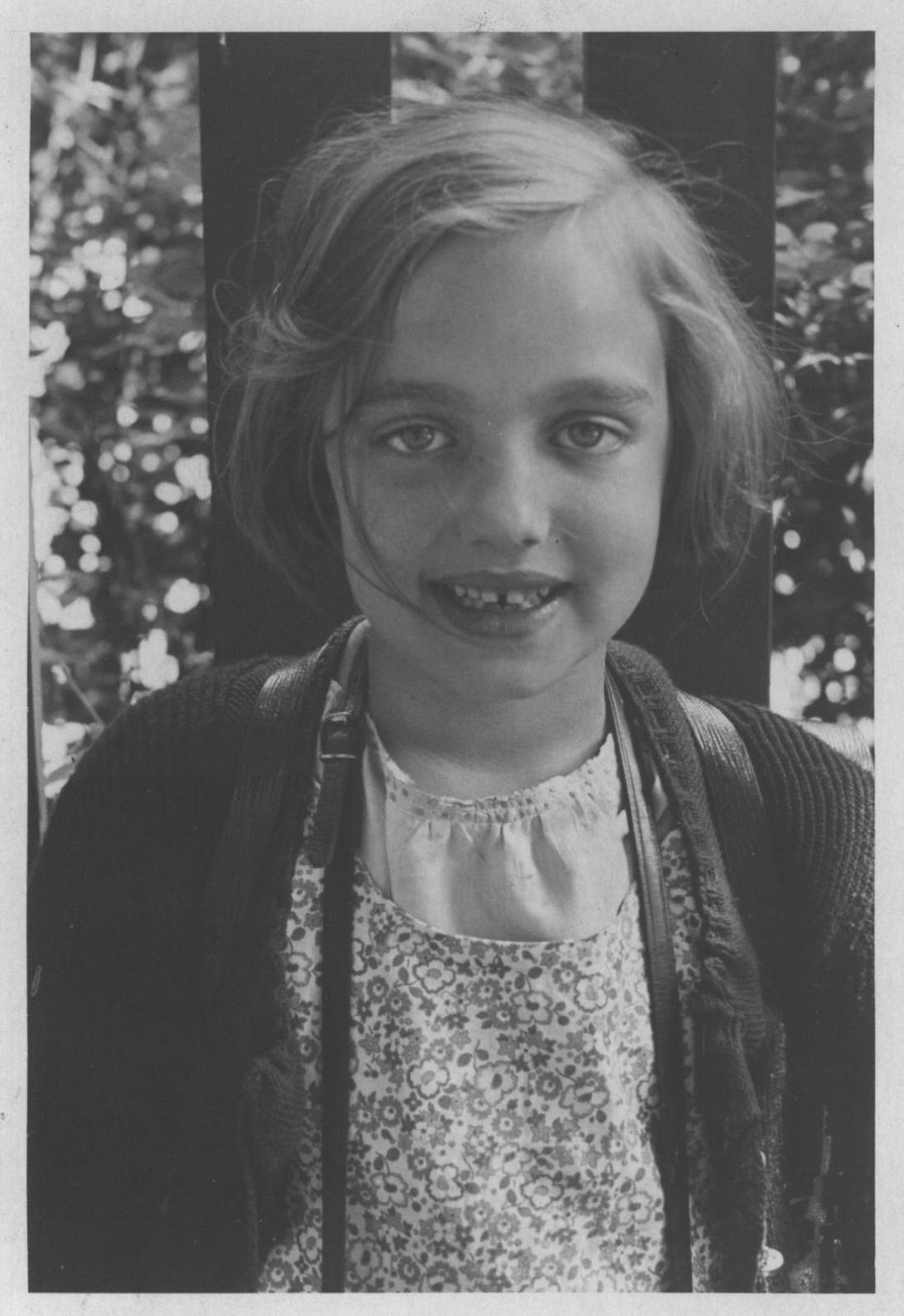
Eva Lilienthal was born on June 10, 1930, in Berlin Schöneberg. Her parents - the Jewish merchant Alfred Lilienthal (born December 4, 1889, in Minden) and the Protestant Johanne, née Beckmann (born December 3, 1900, in Hesepe, Oldenburg district) were married in 1923. Eva's mother, Johanne, was a stenographer and office clerk, and Eva's father, Alfred, was in the shipping business and had worked for a transport company in Berlin since 1919. From 1928, Eva's parents lived at 5 Belziger Strasse in Schöneberg.
In 1932, Eva's father became managing director of the transport company - a circumstance that probably made it possible for the family to move to a larger apartment at 1 Bornstrasse in Friedenau. This representative residential-and-commercial building was a large corner building that stretched from Bornstrasse 1 across Schlossstrasse to Walter-Schreiber-Platz. It was destroyed in World War II. The ruins were demolished and a new, modern department store (then Hertie) was built on the original floor plan. The residential building at 1 Bornstrasse was not rebuilt.
In 1936, Eva started school at the Rheingau School in Friedenau. From 1937 onwards, the family's situation changed dramatically: as the child of a Jewish family, Eva felt increasingly excluded. Her father, Alfred, was released from his role as managing director by his employer in 1937. After the decree of the Reich Ministry of Economics of May 31, 1938, according to which no more contracts could be awarded to Jews/Jewish companies, Alfred was finally terminated on June 1, 1938. Neither his participation as a front-line soldier in the First World War nor the "Cross of Honor for Front Fighters" awarded to him in 1935 protected her father from reprisals. Eva had to be deregistered from school. In October, 1938, Eva's father's identity card was confiscated. On November 9, 1938, her father was arrested during the pogrom and deported to the Sachsenhausen concentration camp . In return for paying a larger sum as a "Jewish property levy," Eva's father was released on the condition that he leave Germany as quickly as possible.
On April 18, 1939, eight-year-old Eva and her parents boarded the passenger ship "Scharnhorst" in Bremerhaven and fled Germany. The destination was the only port that was still visa-free for Jews - Shanghai. Eva's father, Alfred Lilienthal, had given Melchers & Co., 210 Kiukiang Road, POB 1004 as the arrival address in Shanghai. Kiukiang Road - now Jiujiang Road - was considered a trading center for European companies and bankers in the 1920s and was considered the "Wall Street of the East". Alfred Lilienthal, as a long-time international freight forwarder, probably had good contacts overseas that he could use to prepare for the escape.
In fact, life in Shanghai was not easy for the emigrants. It was out of the question for Eva to attend school on an orderly basis - especially not with a qualification that would have enabled access to qualified training. For a few months, Eva was able to continue learning in a "private school" set up by emigrants, where only partially trained teachers taught.
In 1943 the Japanese occupied Shanghai. The private schools were closed and now only the Chinese primary schools were available. As well, a ghetto was set up for Chinese and Jewish refugees. Eva's father was also sent here. Eva and her mother were separated from Alfred. He was only allowed to leave the ghetto with a pass - one of these was only issued to him once, when he was summoned to the German Consulate General. Eva's parents were summoned there to consent to a divorce - which both parents rejected.
With the end of the Second World War and the occupation of Shanghai by the Americans, the family was able to reunite. Eva eventually took a job as an unskilled saleswoman in a men's goods store. It was not until December 1950 that Eva and her mother, Johanne, were able to leave Shanghai and return to Germany. Father Alfred had to travel back separately and, after his arrival in January 1951, was initially sent to the Föhrenwald camp in Bavaria as a stateless person.
Eva went to Wiesbaden in the spring of 1951, and her mother, Johanne, accompanied her. On the return journey by ship to Germany, Eva met Jürgen Kurt Jedicke and became engaged to him. Her fiancé found a job with the US Air Force in Wiesbaden, where Eva was also able to work and thus earn a living for herself and her mother. Due to her long stay in Shanghai, Eva spoke English quite well and completed courses in English shorthand and typing. While Eva and her mother lived in Wiesbaden from then on, her father, Alfred, returned to Berlin after his release from the Föhrenwald camp. The family remained separated. In 1954, Eva Lilienthal married her fiancé, Jürgen Kurt Jedicke. In 1956, the young couple emigrated to Canada with their now one-year-old son, Peter, and mother, Johanne.
Eva and her mother remained in close contact with Alfred and returned to their old hometown of Berlin for visits. Both of Eva's parents died in June 1970, her father in Berlin, her mother in Canada.
All texts and images on this website are protected by copyright and may not be used without the permission of the copyright holder.