
- Location
- Bornstr. 1
- District
- Friedenau
- Stone was laid
-
30 April 2024
- Born
- 03 December 1900 in Hesepe (Bezirk Osnabrück)
- Occupation
- Stenotypistin und Kontoristin
- Escape
- 1939 mit jüdischem Ehemann nach Shanghai
-
Survived
-
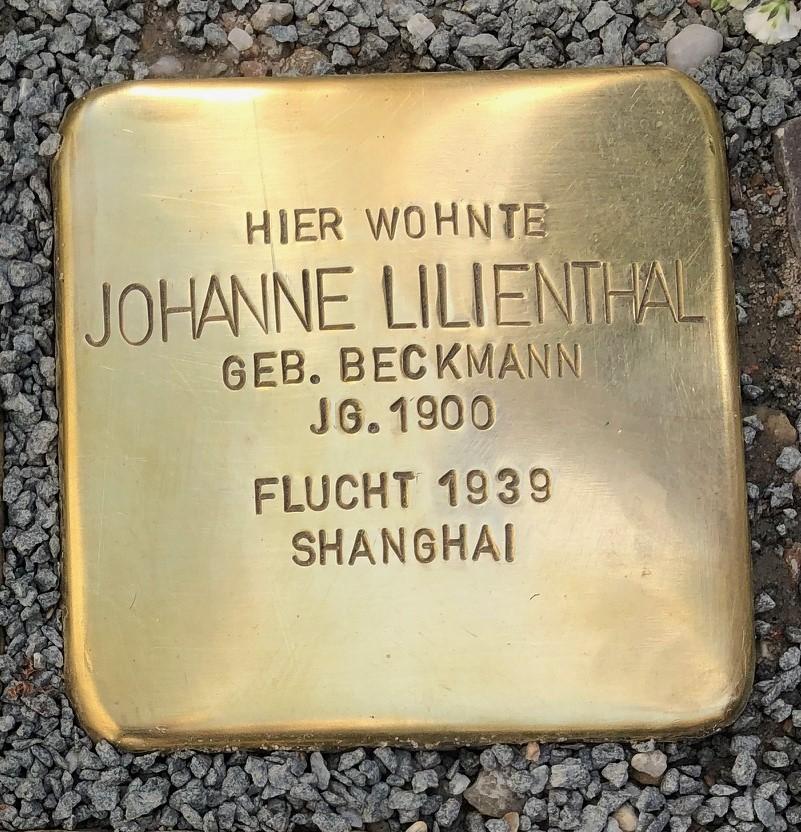
 Stolperstein Johanne Lilienthal geb. Beckmann © S. Davids
 -
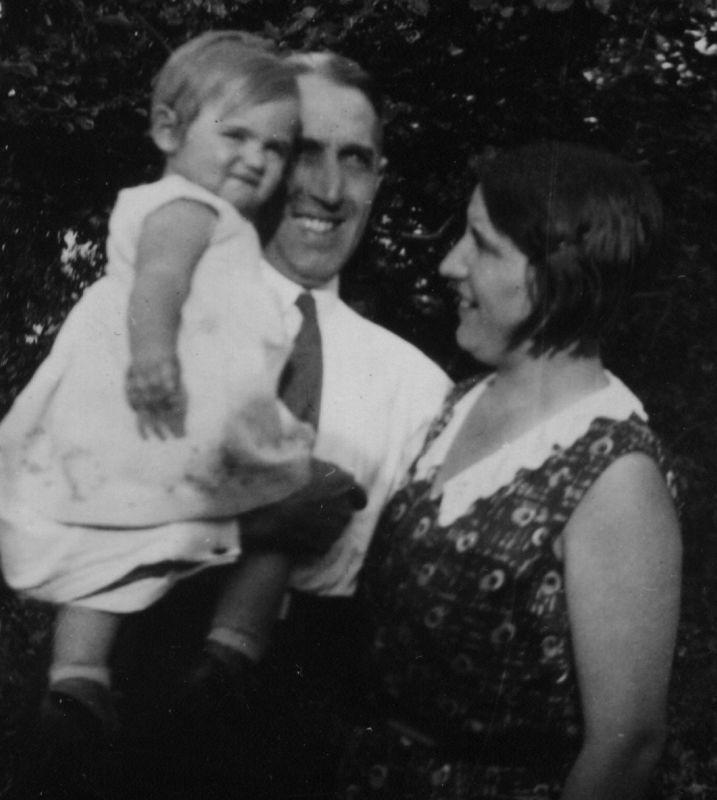
ca. 1931 Familie Lilienthal © Familienbesitz
Johanne Beckmann was born on December 3, 1900 in Hesepe (Osnabruck district) born. She came from a Protestant family. She worked as a stenographer and office clerk. On May 12, 1923, she married the forwarding agent Alfred Lilienthal (born December 4, 1889 in Minden) in Aachen, who came from a Jewish family in Minden. Alfred Lilienthal's father Bruno was the manager of a bank at 29 Lindenstrasse (formerly 19 Obermarktstrasse) in Minden. However, Alfred Lilienthal had already lived in Berlin since 1919.
After her marriage to Alfred, Johanne moved to Berlin, where the couple initially lived at 56 Kommandanten Strasse and then from 1925 to 1932 at 5 Belziger Strasse in Schöneberg. Their daughter Eva was born on June 10, 1930. In 1932, they moved from Schöneberg to a much larger apartment in Friedenau at 1 Bornstrasse, Staircase II. Alfred Lilienthal had now become managing director of the transport company where he had been employed since 1919 - which company this was, unfortunately, could not be found in the files. Apparently, however, this promotion enabled the family to move into this representative residential-and-commercial building, which was a large corner house from 1 Bornstrasse via Schlossstrasse to Walter-Schreiber-Platz. It was destroyed in World War II. The ruins were demolished and a new, modern department store (then Hertie) was built on the old floor plan. The 1 Bornstrasse residential building was not rebuilt.
The Lilienthal family also felt the increasing reprisals against Jews from 1933 onwards when the National Socialists came to power. In 1935, Alfred Lilienthal received the Cross of Honour for frontline fighters, which had been donated a year earlier by Reich President Hindenburg on the occasion of the 20th commemoration of the start of the war in 1914. Because of his participation in the First World War and the "award" he received, Alfred Lilienthal, like many Jewish former front-line soldiers, held on to the hope that, as a Jew, he and his family would not face any restrictions.
The family celebrated together when their daughter Eva started school at the Rheingau School in Friedenau in 1936.
But as early as 1937, the life of Johanne and her family changed dramatically: Alfred Lilienthal was released from his role as managing director by his employer. On June 1, 1938 - immediately after the Reich Ministry of Economic Affairs' decree of May 31, 1938, according to which no more contracts could be awarded to Jews/Jewish companies, Alfred was finally terminated. Immediately during the progrom on November 9, 1938, he was arrested and interned in the Sachsenhausen concentration camp . Eight-year-old Eva was banned from attending school. After paying a considerable amount of Reich escape tax and Jewish property levy, Alfred was released from prison on the condition that he leave Germany as quickly as possible. So on April 18, 1939, the family boarded the steamer "Scharnhorst" in Bremerhaven bound for Shanghai - the only place that Jews could reach without a visa.
The family initially lived together there under difficult circumstances. In 1943, after the Japanese came to power, Alfred was sent to the ghetto, which, from then on, he was only allowed to leave with a pass. Johanne and Alfred were summoned to the German Consulate General and asked to divorce. Both spouses refused this. It was only after the end of the Second World War and with the arrival of the Americans in Shanghai that the couple were able to get together again.
In December 1950, Johanne Lilienthal and her daughter Eva were able to leave Shanghai and return to Germany. Alfred had to travel back separately and, after his arrival in January 1951, was initially sent to the Föhrenwald camp in Bavaria as a "stateless" and "displaced person." The family remained separated. Johanne went to Wiesbaden with her daughter Eva in the spring of 1951, where Eva was able to take a job in the US Air Force through her fiancé Jürgen Kurt Jedicke. Johannes' husband Alfred returned to Berlin after his release from the Föhrenwald camp - where he lived until his death.
Her daughter Eva married her fiancé, Jürgen Kurt Jedicke, in Wiesbaden in 1954. In 1956, Johanne emigrated to Canada with her daughter Eva, son-in-law and now one-year-old grandchild, Peter.
Johanne and Eva remained in close contact with Alfred and returned to Berlin for visits. Just three weeks after the death of her husband Alfred on June 6, 1970, in Berlin, Johanne died on June 30, 1970 in Canada.
All texts and images on this website are protected by copyright and may not be used without the permission of the copyright holder.